
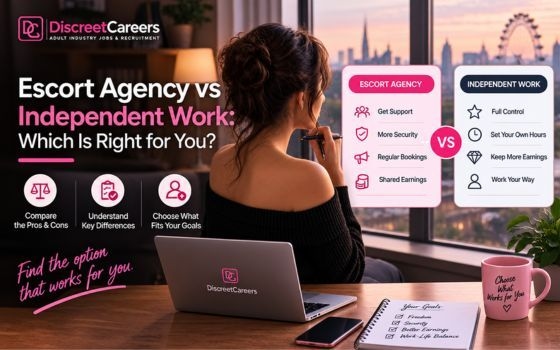
Introduction
Choosing between agency and independent work can affect how you find bookings, manage your time, handle administration and receive payment.
Neither option is automatically right for everyone. The best choice depends on how much control you want, how comfortable you are managing the business side of your work and what type of support you are looking for.
Agency work vs independent work
The main difference is who manages the business side of the work.
What is Escort Agency Work?
With an agency arrangement, the agency may handle some of the tasks involved in finding and organising bookings. Depending on the employer, this can include enquiries, scheduling, advertising, client communication and administrative support.
The exact arrangement varies, so check what the agency actually provides and what you are expected to manage yourself.
What Is Independent Escort Work?
Independent escorts generally manage their own business activities. This can include advertising, enquiries, bookings, scheduling, payment arrangements and other administration.
Working independently can give you more control, but it also means taking responsibility for tasks that an agency may otherwise handle.
How to Decide Which Is Right for You: Think about how you prefer to work.An agency may suit you if you:
Independent work may suit you if you:
There is no single “best” route. Focus on the actual terms, responsibilities, costs and level of control offered by the opportunity you are considering.
Key Differences at a Glance
- Bookings — Agency: handled by the agency. Independent: you handle them.
- Marketing — Agency: the agency promotes you. Independent: you promote yourself.
- Client screening — Agency: the agency screens clients. Independent: you are responsible.
- Support — Agency: team and office support. Independent: you rely on your own support.
- Flexibility — Agency: less flexibility on rules. Independent: complete independence.
- Earnings — Agency: split with the agency. Independent: you keep 100%.
- Best for — Agency: beginners or those wanting support. Independent: experienced or business-minded.
Pros of Agency Work
- Support with enquiries and bookings
- Less responsibility for some marketing and administration
- Access to an established business or client base
- Help with scheduling and logistics, depending on the agency
- A team or point of contact for work-related questions
Pros of Independent Work
- Complete control and flexibility
- Keep 100% of your earnings
- Build your own brand
- Work on your own terms
- No agency rules or restrictions
Safety Considerations
Safety matters whether you work through an agency or independently.
Before accepting an opportunity:
Check who you are dealing with
Understand how bookings and communication are managed
Make sure payment terms are clear
Protect your personal information
Keep appropriate records of important arrangements
Tell someone you trust about your plans where appropriate
Be cautious about unexpected requests for money or personal information
Do not feel pressured to accept work you are uncomfortable with
An agency does not automatically make an opportunity safe, and working independently does not automatically make it unsafe. The actual procedures, people involved and working arrangements matter.
For more guidance, visit the Discreet Careers Safety Centre.
Can You Switch Between Agency and Independent Work?
Yes, your working arrangement can change over time.
Someone may start with an agency to gain experience with bookings and administration before deciding to work independently. Others may work independently and later choose an agency because they want additional support or a different working arrangement.
Before changing arrangements, check any existing agreement for restrictions, notice requirements or other conditions that could affect your plans.
If you move to independent work, remember that you will need to manage responsibilities that may previously have been handled by someone else, such as advertising, enquiries, scheduling, records and expenses.
Frequently Asked Questions
Which pays more: agency or independent work?
There is no standard answer. Agency work may involve commission or an agreed share in return for services and support, while independent workers receive payments directly but take responsibility for their own business costs. Compare the actual income and expenses involved rather than the headline rate alone.
Is agency work safer than working independently?
Not automatically. An agency may have screening or support procedures, but the quality of those arrangements varies. Independent workers have more responsibility for managing their own checks and safety procedures. In either case, understand how the work is organised and take reasonable safety precautions.
Can I switch from agency to independent work later?
You may be able to, but check your existing agreement first. There may be notice requirements or restrictions on certain activities. If you decide to work independently, make sure you are prepared to manage bookings, administration, advertising and other responsibilities yourself.
Ready to Explore Escort Jobs?
Compare current escort agency vacancies on Discreet Careers and review the advertised role, working arrangements, pay and requirements before applying.